

Flowmeter
Your Professional Flowmeter Supplier
We also focus on the research and development as well as manufacturing of high-end liquid precision flow meters, aiming to compete with international leading brands. We provide high-reliability solutions in the field of micro-flow measurement and control. Relying on core technologies such as full-metal sealing and millisecond response, our products continuously improve in terms of accuracy, stability and corrosion resistance. They have been widely applied in industries such as water supply, fire protection and pharmaceuticals. As a professional supplier in the field of precise fluid measurement and control, we adhere to the principle of "linking trust through flow", using every precise data to assist customers in upgrading their processes and achieving green manufacturing.


Why choose us
Our Certificate
ISO9001, ISO14001, ISO45001, IATF16949. UL, CMA, SGS.
Sales Market
We export our products to over 20 countries around the world. These include the United States, countries in Europe, and nations in Southeast Asia.
Our service
Before shipment: Laboratory Test and Bulk Inspection.
Electrical Type Flow Meter
An electrical type flow meter, most commonly referring to an electromagnetic flow meter, measures the flow of conductive fluids by using Faraday's Law of Induction to create an electrical signal. It works by passing a magnetic field through a pipe, which induces a voltage in the fluid as it flows through. This voltage is directly proportional to the fluid's velocity, which is then translated into a flow rate reading.
Key features
No moving parts
Electromagnetic meters are obstructionless, meaning they have no moving parts, which reduces maintenance and pressure drop.
Conductive fluids only
They are designed to work only with conductive liquids, such as water, wastewater, and many chemicals.
High accuracy
These meters can provide very accurate measurements and have a wide "turndown" range, meaning they can measure a broad range of flow rates accurately.
Versatility
They can be used in a wide variety of applications, including wastewater treatment, food and beverage, and chemical processing.
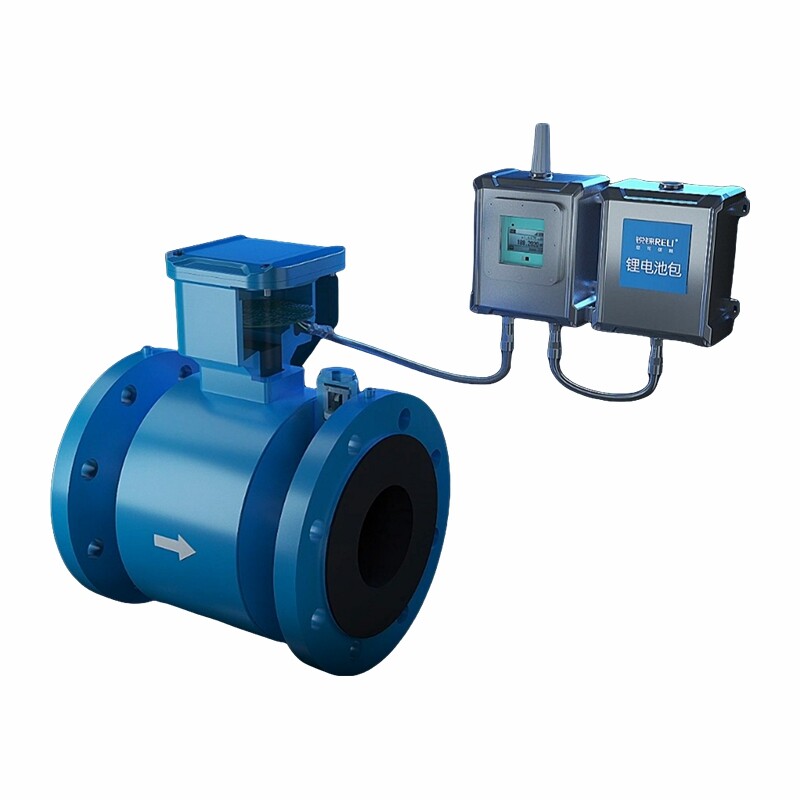
The measurement channel is a smooth straight tube and will not be blocked. Suitable for measuring liquid-solid two-phase fluids containing solid particles, such as pulp, mud, sewage, etc.
There is no pressure loss caused by flow detection, and the energy saving effect is good.
The measured volumetric flow rate is virtually unaffected by changes in fluid density, viscosity, temperature, pressure and conductivity.
Large flow range and wide caliber range.
Corrosive fluids can be used.
How it works
Magnetic field
The meter creates a magnetic field across the entire cross-section of the pipe.
Induced voltage
As a conductive fluid passes through this magnetic field, it generates a small electrical voltage.
Proportional relationship
The strength of this voltage is directly proportional to the velocity of the fluid flowing through the pipe.
Measurement
Electrodes in the meter's sensor pick up this induced voltage. A transmitter then converts the voltage signal into a volumetric flow rate, such as gallons per minute.
Monitoring: Operators can ensure proper operation and efficiency by using a flow meter to monitor flow rates and masses.
Leak detection: Monitoring flow rates can help to detect leaks in pipelines, minimizing wastage and potential environmental damage.
Safety
Flow measurement, along with proper pressure gauges usage, can help prevent overpressure in pipelines. Also, flow measurement helps to maintain proper flow rates for cooling in industrial processes.
Billing
Accurate measurement of fluid flow rates and masses is necessary for billing and regulatory purposes in many industries.
Environmental compliance
Flow meters can measure emissions, effluent discharges, and water usage, helping industries comply with environmental regulations.
Selection criteria
Consider the following criteria when selecting a flow meter:
Connection size
When connecting a flow meter to a pipe, ensure the same sizes.


Connection type
There are different connection types available, including flanged, threaded, and clamp connections.
Pressure and temperature
Ensure the flow meter can handle the system's normal pressure and temperature conditions.


Fluid type
Make sure the flow meter can handle the fluid, whether liquid or gas. Understand the fluid's properties, such as density, viscosity, and conductivity.
Accuracy and repeatability
Different applications require different accuracies. A flow meter's accuracy is expressed in percentages, such as 1%. The lower the percentage, the higher the accuracy.

Installation location
Different flow meters have different requirements on where they can be installed in a system. Be sure to read installation instructions carefully. Read our flow meter installation article for more information on issues during fluid measurement and proper mounting techniques for the flow meter.
Industrial Uses
Velocity flow meters are utilized in various industries for numerous applications, including:
Water Treatment and Distribution
For measuring the flow of water in treatment plants and distribution systems.
01
Chemical and Pharmaceutical Industries
To monitor and control the flow of chemicals, solutions, and other fluids in manufacturing processes.
02
Oil and Gas Sector
For the measurement of hydrocarbon flow in pipelines and processing facilities.
03
Food and Beverage Production
To ensure accurate flow rates of liquids in processing plants, including water, oils, and other ingredients.
04
Energy and Power Generation
For measuring the flow of steam, cooling water, and other fluids associated with power generation.
05
FAQ
We're well-known as one of the leading flowmeter manufacturers and suppliers in China. Please feel free to wholesale high quality flowmeter from our factory. For customized service, contact us now.
explosion proof flow meter, Electromagnetic Meter for Water, flowmeter