

Transformers are an essential part of our electrical infrastructure, found everywhere from power plants to the small devices in our homes. At the heart of these transformers are copper coils, playing a role so crucial that without them, the efficient transmission and distribution of electrical energy would be next to impossible. As a copper coils supplier, I've seen firsthand how these unassuming loops of wire are the unsung heroes of the electrical world.
The Basic Principle of Transformers
Before diving into the role of copper coils, let's quickly cover how transformers work. The basic concept behind a transformer is electromagnetic induction. It consists of two or more coils of wire wound around a magnetic core. When an alternating current (AC) passes through one coil, called the primary coil, it creates a changing magnetic field in the core. This changing magnetic field then induces an electromotive force (EMF) in the other coil, known as the secondary coil. The ratio of the number of turns in the primary and secondary coils determines the voltage transformation ratio of the transformer.
Why Copper Coils?
Now, you might be wondering why copper is the go - to material for these coils. Well, copper has some fantastic electrical properties. It has a very low electrical resistivity. This means that when an electric current flows through a copper coil, there's less resistance to the flow of electrons. Less resistance translates into less energy being lost as heat during the transmission of electricity. In a transformer, where efficiency is key, this low resistivity of copper is a huge advantage.
Another great thing about copper is its high thermal conductivity. Since some heat is still generated in the coils during operation, the ability of copper to quickly dissipate this heat helps keep the transformer at a safe operating temperature. Overheating can damage the insulation on the coils and reduce the lifespan of the transformer, so copper's thermal properties are essential for long - term and reliable performance.
Role of Copper Coils in Step - up and Step - down Transformers
There are two main types of transformers: step - up and step - down. In a step - up transformer, the secondary coil has more turns than the primary coil. The copper coils in a step - up transformer are responsible for increasing the voltage of the electrical energy. This is crucial in power generation and transmission. Power plants generate electricity at relatively low voltages. But to transmit this electricity over long distances efficiently, the voltage needs to be increased. High - voltage transmission reduces power losses in the transmission lines. The copper primary coil takes in the low - voltage AC, and the magnetic field created by it induces a higher voltage in the secondary copper coil.
On the other hand, step - down transformers have fewer turns in the secondary coil compared to the primary coil. These are commonly found in substations and in our homes. When the high - voltage electricity reaches a local area, it needs to be stepped down to a safe and usable voltage for household appliances and industrial equipment. The copper coils in step - down transformers perform this vital function of reducing the voltage to a level that can be safely used by consumers.
Different Types of Copper Coils for Transformers
As a copper coils supplier, I offer a variety of copper coils that are suitable for different transformer applications. One of them is the Stranded Copper Coil. Stranded copper coils are made up of multiple small copper strands twisted together. This design has several advantages. It increases the flexibility of the coil, making it easier to wind around the transformer core. It also helps to reduce the skin effect. The skin effect is a phenomenon where, at high frequencies, the alternating current tends to flow more on the outer surface of the conductor. By using a stranded coil, the effective surface area for the current flow increases, reducing the resistance and improving the overall performance of the transformer.

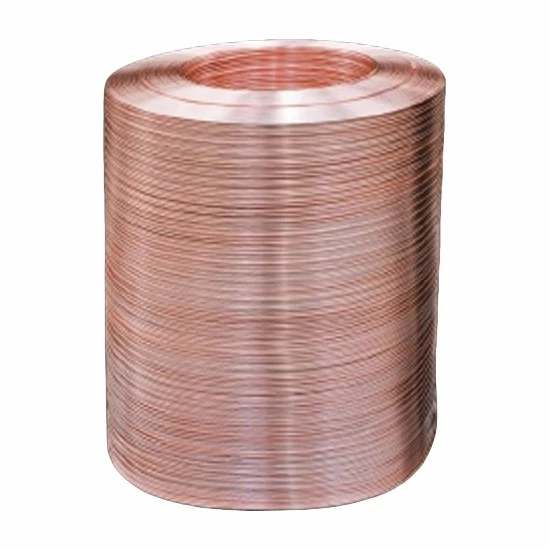
Another type is the Jumbo Coil. Jumbo coils are larger in size and are often used in high - power transformers. These transformers are typically found in power plants and large industrial facilities. The large size of the jumbo coils allows them to handle higher currents and voltages. They are designed to be robust and can withstand the high - stress operating conditions of large - scale electrical systems.
Enameled Copper Wire is also widely used in transformers. The enamel coating on the copper wire serves as an insulator. It prevents short - circuits between adjacent turns of the coil. This is essential because in a transformer, the coils are wound very closely together. Without proper insulation, the current could flow between the turns instead of through the entire length of the coil, which would disrupt the normal operation of the transformer.
Quality and Performance
When it comes to copper coils for transformers, quality is of utmost importance. The quality of the copper used, the precision of the winding, and the integrity of the insulation all affect the performance and lifespan of the transformer. As a supplier, I ensure that all our copper coils are made from high - purity copper. High - purity copper has even lower resistivity and better thermal conductivity, which further improves the efficiency of the transformer.
The winding process is also carefully controlled. Precise winding ensures that the magnetic field generated by the primary coil is effectively coupled to the secondary coil. Any irregularities in the winding can lead to a reduction in the efficiency of the transformer and even cause overheating.
In terms of the insulation, we use high - quality enamel coatings that can withstand high temperatures and electrical stresses. This helps to prevent breakdowns and ensures the long - term reliability of the transformer.
Conclusion and Call to Action
Copper coils are the lifeblood of transformers, enabling the efficient transmission and distribution of electrical energy. Whether it's for a small household transformer or a large - scale power plant transformer, the right copper coils are essential for optimal performance.
If you're in the market for high - quality copper coils for your transformer applications, I'd love to have a chat with you. We have a wide range of copper coils, including Stranded Copper Coil, Jumbo Coil, and Enameled Copper Wire, to meet your specific needs. Contact us to start a discussion about your requirements and how we can provide the best copper coil solutions for you.
References
- Grover, F. W. (1946). Inductance Calculations: Working Formulas and Tables. Dover Publications.
- Chapman, S. J. (2012). Electric Machinery Fundamentals. McGraw - Hill.
- Fitzgerald, A. E., Kingsley Jr, C., & Umans, S. D. (2003). Electric Machinery. McGraw - Hill.