

Copper is one of the most widely used metals in various industries, and copper bars are a common form of copper products. As a copper bar supplier, I often receive inquiries about the conductivity of copper bars. In this blog post, I will explain what the conductivity of a copper bar is, why it matters, and how it relates to our products.
What is Conductivity?
Conductivity is a measure of a material's ability to conduct electric current. It is the reciprocal of resistivity, which is a measure of how strongly a material opposes the flow of electric current. The SI unit of conductivity is siemens per meter (S/m).
In the context of copper bars, high conductivity means that the copper bar can efficiently transmit electrical energy with minimal loss. This is crucial in applications where electrical power needs to be transferred over long distances or where high currents are involved, such as in electrical power distribution systems, electrical motors, and electronic devices.
Conductivity of Copper
Copper is well - known for its excellent electrical conductivity. Among all non - precious metals, copper has one of the highest electrical conductivities. At room temperature (20°C), the electrical conductivity of pure copper is approximately 5.96×10⁷ S/m.
The high conductivity of copper is due to its atomic structure. Copper has one valence electron in its outermost shell, which is relatively free to move within the metal lattice. When an electric field is applied, these free electrons can easily flow through the copper, creating an electric current.
Factors Affecting the Conductivity of Copper Bars
While pure copper has a high conductivity, the conductivity of copper bars can be affected by several factors:
Impurities
The presence of impurities in copper can significantly reduce its conductivity. Even small amounts of other elements, such as iron, sulfur, or oxygen, can disrupt the flow of electrons in the copper lattice. For example, iron impurities can form magnetic domains in the copper, which can scatter electrons and increase resistivity. As a copper bar supplier, we ensure that our copper bars are made from high - purity copper to maintain their high conductivity.
Temperature
The conductivity of copper is also temperature - dependent. As the temperature increases, the conductivity of copper decreases. This is because at higher temperatures, the atoms in the copper lattice vibrate more vigorously, which scatters the free electrons and makes it more difficult for them to flow. The relationship between conductivity and temperature can be described by the following equation:
[ \sigma_T=\sigma_0\frac{1}{1 + \alpha(T - T_0)} ]
where (\sigma_T) is the conductivity at temperature (T), (\sigma_0) is the conductivity at a reference temperature (T_0) (usually 20°C), and (\alpha) is the temperature coefficient of resistivity of copper (approximately 0.00393/°C).
Cold Working
Cold working, such as rolling or drawing, can also affect the conductivity of copper bars. Cold working can introduce dislocations and grain boundaries in the copper microstructure, which can scatter electrons and reduce conductivity. However, the effect of cold working on conductivity is usually relatively small compared to the effects of impurities and temperature.
Importance of Conductivity in Copper Bar Applications
The high conductivity of copper bars makes them suitable for a wide range of applications:
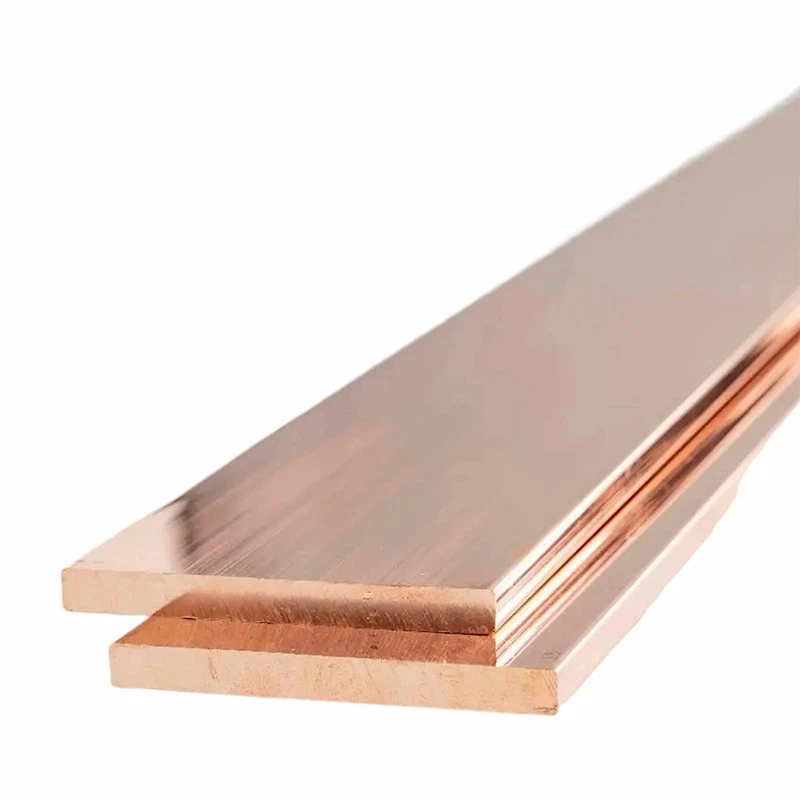

Electrical Power Distribution
In electrical power distribution systems, copper bars are used as busbars to carry large amounts of electrical current from power sources to various electrical equipment. High - conductivity copper bars can minimize power losses during transmission, which is essential for improving the efficiency of the power system. Our High Conductivity Copper Busbar is specifically designed for these applications, ensuring reliable and efficient power distribution.
Electrical Motors
Copper bars are also used in the windings of electrical motors. The high conductivity of copper allows for efficient conversion of electrical energy into mechanical energy. By using high - conductivity copper bars, motors can operate more efficiently, consume less energy, and generate less heat.
Electronic Devices
In electronic devices, such as printed circuit boards (PCBs) and integrated circuits, copper bars are used for interconnects. The high conductivity of copper ensures fast signal transmission and reduces signal attenuation, which is crucial for the proper functioning of electronic devices.
Our Copper Bar Products
As a copper bar supplier, we offer a variety of copper bar products with high conductivity. Our Customize High Quality Copper Bar service allows customers to get copper bars tailored to their specific requirements, whether it's for a small - scale electronic project or a large - scale power distribution system.
We also provide Rigid Copper Bar, which is ideal for applications where mechanical strength and stability are required. These rigid copper bars maintain their high conductivity while providing the necessary structural support.
Contact Us for Procurement
If you are in need of high - conductivity copper bars for your project, we are here to help. Our team of experts can provide you with detailed information about our products, including their conductivity, dimensions, and specifications. We can also offer competitive pricing and excellent customer service.
Whether you are an electrical engineer, a manufacturer, or a distributor, we welcome you to contact us for procurement and negotiation. We are committed to providing you with the best copper bar solutions to meet your needs.
References
- Ashby, M. F., & Jones, D. R. H. (2012). Engineering Materials 1: An Introduction to Properties, Applications, and Design. Butterworth - Heinemann.
- Callister, W. D., & Rethwisch, D. G. (2014). Materials Science and Engineering: An Introduction. Wiley.
- Groover, M. P. (2010). Fundamentals of Modern Manufacturing: Materials, Processes, and Systems. Wiley.